
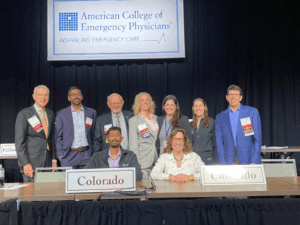
Colorado ACEP Council Delegation at ACEP25 (Salt Lake City, UT)
The annual ACEP 2025 Council meeting took place in Salt Lake City, Utah, from September 4 to 6, followed by the educational Scientific Assembly (ACEP25) from September 7 to 10.
Councilors and alternates representing Colorado included Drs. Ricky Dhaliwal, Laura Edgerley-Gibb, Doug Hill, Bill Hilty, Rebecca Kornas, Abby Leibowitz, Carla Murphy, Kristen Nordenholz, Parth Shah, and James Thompson. Past ACEP President Brooks Bock sat with our delegation.
Congratulations to the newly elected national ACEP leaders chosen by the ACEP Council:
- President: L. Anthony Cirillo, MD, FACEP, assumed the presidency. Dr. Cirillo has been a practicing emergency physician for over 30 years and currently practices as a regional traveler as well as the director of government affairs for US Acute Care Solutions.
- President-Elect: Ryan A. Stanton, MD, FACEP, of Kentucky, was chosen as President-Elect. Dr. Stanton is an emergency physician and the president of Central Emergency Physicians in Kentucky. Dr. Stanton is an EMS medical director and creator/host of ACEP Frontline podcast.
- Council officers:
Speaker: Michael McCrea, MD, FACEP, of Ohio - Vice Speaker: Larisa Traill, MD, FACEP, of Michigan
- Four newly elected and re-elected members of the ACEP Board of Directors:
- Daniel Freess, MD, FACEP, of Connecticut
- Steven B. Kailes, MD, MPH, FACEP, of Florida
- Kristin McCabe-Kline, MD, FACEP, of Florida
- Bing S. Pao, MD, FACEP, of California.
- The Board elected officers:
- Chair of the Board: Chad Kraus, DO, DRPH, FACEP
- Vice President-Communications: Henry Pitzele, MD, FACEP
- Vice President: Membership: Heidi Knowles, MD, FACEP
- Secretary -Treasurer: Abhi Metrotra, MD, MBA, FACEP
Council Actions (from the official 2025 summary)
- 36 – Reaffirming Support for 3-Year and 4-Year EM Residency Program
- 41 – Advocate for No-Fault Medical Liability Reform and Redefinition of Negligence in Health Care
- 43 – Support for Eliminating Physician Non-Compete Clauses in Contracts
- 45 – Comprehensive Support for Medicaid and Consolidation of ACEP Medicaid-Related Policies
- 50 – Emergency Department Staffing Transparency
- 51 – Supporting Board-Certified Physicians in Every Emergency Department
- 53 – Prior Authorization Reform to Reduce Delays in Care and Emergency Department Burden
- 56 – Regulate Artificial Intelligence in Health Insurance Reimbursement and Coverage Decisions
- 57 – Repeal Certificate of Need Laws to Expand Access and Improve Patient Care
- 58 – Role of EDs in Interactions with U.S. Immigration and Customs Enforcement
- 61 & 62 – Environmental stewardship: Metered-dose inhaler impact; Promoting sustainability and waste reduction
- 68 – Integrating Firearm Safety Counseling into EM Education and Practice
- 72 – Naloxone Access and Education in Public Schools
- 76 – Protection and National Standardization of Transgender Care in Emergency Medicine
- 80 – Toolkit for Elective Surgery Scheduling to Mitigate ED Crowding
Bylaws Resolutions
21 – Distinguished ACEP Fellow Recognition – Bylaws Amendment
22 – International ACEP Fellow Recognition – Bylaws Amendment
Opening General Session & Keynotes
The opening keynote session included actor Noah Wyle and the real doctors behind “The Pitt,” Drs. Joe Sachs and EMRAP’s Mel Herbert. This keynote was a panel discussion moderated by ACEP president L. Anthony Cirillo, MD, FACEP. Olympic skating champion Scott Hamilton preceded the panel with an engaging talk about his Olympic journey and his experience as a cancer survivor.
Looking Ahead
The next Council meeting will be held on October 3-4, 2026, in Chicago, Illinois, immediately followed by the educational Scientific Assembly (ACEP26). Resolutions are due by July 5.
Scientific Assembly & ACEP Programs
The Scientific Assembly (ACEP25) had 274 CME courses and 60 non-CME courses.
ACEP initiated the EDAP – Emergency Department Accreditation Program; the first emergency department to be accredited was the University of Alabama.
We’re doing three specific kinds of hospital accreditation: 1) geriatric accreditation (now ~550 hospitals), 2) clinical ultrasound accreditation, and 3) pain and addiction accreditation.
Clinical policies remain widely used. The most searched policy is headache, and the specialty that searches ACEP’s clinical policies most often is orthopedics.
On wellness, ACEP’s Physician Wellness Hub continues to expand, offering resources such as an attending bundle, an AI tool, and peer-to-peer support.
Leapfrog is evaluating ED observation.
RAND Report on EP Compensation (2018-2022)
A new RAND analysis showed inflation‑adjusted payments per ED visit declined across all payers. Medicare/Medicaid payments were approximately 3-4% lower per visit; commercial in‑network payments were about 11% lower; and out‑of‑network payments were down roughly 48% over the study period.
Quality, Research & Data
PEER is expanding. ACEP is developing more concise point-of-care tools.
The ACEP Research Academy and E-QUAL (Emergency Quality Network) pursue ongoing projects actively.
EMDI (Emergency Medicine Data Institute), under the guidance of Dr. Todd Taylor, has succeeded the prior CEDR interface; CEDR remains the underlying registry data source for quality reporting.
ACEP Leadership Update
ACEP named Michael Fraser, PhD, as the next Executive Director (start date: November 1). He previously served as the CEO of the College of American Pathologists (CAP), the Association of State and Territorial Health Officials (ASTHO), and the Pennsylvania Medical Society.
Partner Organizations
NEMPAC (National Emergency Medicine Political Action Committee):
The Council Challenge has been in place for more than 25 years. Councilors collectively contribute an average of $250,000 annually to NEMPAC, which accounts for more than one-quarter of the total funds raised each year. NEMPAC also sponsors the Emergency Department Visit Program, which hosts legislators and staff in EDs, with DC staff assisting with logistics. Members can join the 911 Network to receive advocacy alerts and participate in grassroots outreach.
EMF (Emergency Medicine Foundation):
At ACEP25, EMF hosted a Research Showcase, a VIP Reception at the Utah Museum of Contemporary Art, a Major Donor Lounge, and a Silent Auction. The 2025 grant cycle is funding more than $ 500,000 for 14 projects, covering opioid treatment, pediatric burns, cardiology, EMS, and education. New RFPs are now available for projects commencing in July 2026. EMF has now funded nearly $22 million in research since 1972.
ABEM (American Board of Emergency Medicine):
ABEM has a podcast (ABEM General) and recently updated its website. Chair of the Board: Chad Kraus, DO, DRPH, FACEP
Vice President-Communications: Henry Pitzele, MD, FACEP
Vice President: Membership: Heidi Knowles, MD, FACEP
Secretary -Treasurer: Abhi Metrotra, MD, MBA, FACEP
EMRA (Emergency Medicine Residents’ Association):
EMRA celebrated its 50th anniversary last year and has approximately 20,000 members. Approximately 90% of EM residents are members of EMRA. EMRA offers six new or newly updated clinical resources, as well as 36 books, reference cards, digital, and mobile resources.
Colorado Note
The Naloxone Project, a Colorado-based nonprofit, distributed approximately 4,500 doses of naloxone at ACEP 25.
Submitted by
Carla Murphy, DO, FACEP
CO ACEP Past President
Councilor